

“So, friends, every day do something that won't compute...Give your approval to all you cannot understand...Ask the questions that have no answers. Put your faith in two inches of humus that will build under the trees every thousand years...Laugh. Be joyful though you have considered all the facts....Practice resurrection.”
― Wendell Berry
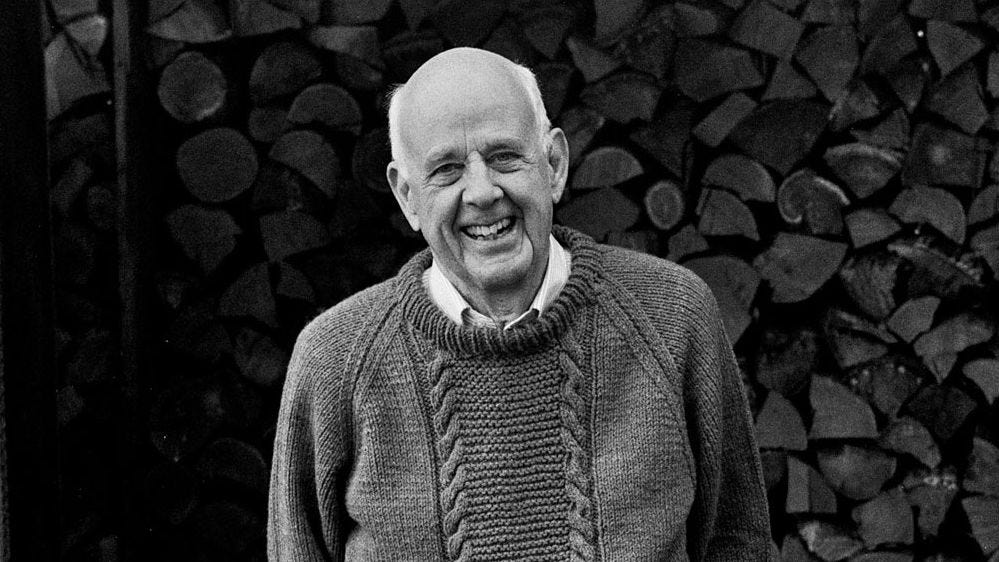
We lost a great one on Monday, August 31. American writer Wendell Berry died at his home in Port Royal, Kentucky. He was 92.
I have to admit, this one hit me pretty hard. Berry has always been a guiding voice in my life. I’ve been reading his essays and poetry for the last 20 years. He’s one of the few writers I return to often. Especially in today’s feverish world that’s bent on completely shunning the simple and poetic wisdom of this great soul.
"As Thoreau so well knew, and so painstakingly tried to show us, what a man most needs is not a knowledge of how to get more, but a knowledge of the most he can do without, and of how to get along without it."
~ Wendell Berry
In a world that says go faster. Buy more. Become richer. Move on. Evolve with the times.
Wendell Berry stayed. He stayed on his land in Kentucky, working with his hands. He stayed rooted in the soil. He stayed with his wife, family, and community. He stayed planted, like an ancient Oak, enduring the demented winds of time.
In an age of abstraction and a maniacal fetish for progress, Berry stood firm in the particulars: this field, this creek, this neighbor, this marriage, this meal, this tree, this community.
In an age that worships the future, he reminded us of inheritance. In an age of boundless appetite, he spoke of limits.
“We learn from our gardens to deal with the most urgent question of the time: How much is enough?”
—Wendell Berry
Throughout all his writings, Berry simply asked: How should human beings live well in a place? In the global mayhem of a corporatized world, Berry remained a fierce defender of local communities and an advocate for returning economic self-determination to the people.
“You can best serve civilization,” he writes, “by being against what usually passes for it.”
As Norman Wirzba writes about Berry:
Writing of the post–World War II era, an era marked by the mass migration of farmers to the city, Berry observed in The Hidden Wound: People had begun to live lives of a purely theoretical reality, daydreams based on the economics of success.
It was as if they had risen off the earth into the purely hypothetical air of their ambition and greed. They were rushing around in the clouds, “getting somewhere,” while their native ground, the only meaningful destination, if not the only possible one, lay far below them, abandoned and forgotten, colonized by machines.
He goes on to write:
Berry believes it is time for us to take full responsibility for the life-denying character of our histories and see in our damaged and exhausted landscapes the effects of a perverted desire. It is time for us to recognize that disembodied desire, desire cut off from the natural and social webs of interdependence, eventually leads to our own homelessness.
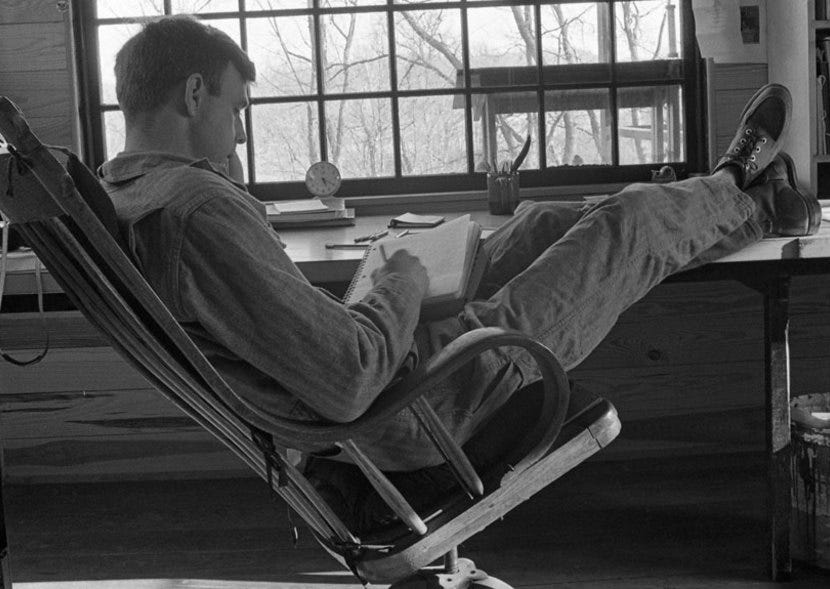
Wendell Berry was an activist, in the creative sense. He was a husband, father, and a kind, useful neighbor in his community. He was a farmer, poet, and one of those increasingly rare writers whose work cannot really be separated from the way he chose to live.
“Nobody can discover the world for somebody else. Only when we discover it for ourselves does it become common ground and a common bond and we cease to be alone.”
— Wendell Berry
For a writer who devoted his life to the bonds between the living, the dead, and the land beneath our feet, he will always remain an ardent and eloquent voice for rootedness, fidelity, limits, and belonging.
Below, I’d like to share a beautiful poem that I think captures the essence of this man's voice, which we will greatly miss. I hope you enjoy it.
The Gift of Gravity
All that passes descends,
and ascends again unseen
into the light: the river
coming down from sky
to hills, from hills to sea,
and carving as it moves,
to rise invisible,
gathered to light, to return
again. "The river's injury
is its shape." I've learned no more.
We are what we are given
and what is taken away;
blessed be the name
of the giver and taker.
For everything that comes
is a gift, the meaning always
carried out of sight
to renew our whereabouts,
always a starting place.
And every gift is perfect
in its beginning, for it
is "from above, and cometh down
from the Father of lights."
Gravity is grace.
All that has come to us
has come as the river comes,
given in passing away.
And if our wickedness
destroys the watershed,
dissolves the beautiful field,
then I must grieve and learn
that I possess by loss
the earth I live upon
and stand in and am. The dark
and then the light will have it.
I am newborn of pain
to love the new-shaped shore
where young cottonwoods
take hold and thrive in the wound,
kingfishers already nesting
in a hole in the sheared bank.
"What is left is what is"--
have learned no more. The shore
turns green under the songs
of the fires of the world's end,
and what is there to do?
Imagine what exists
so that it may shine
in thought light and day light,
lifted up in the mind.
The dark returns to light
in the kingfisher's blue and white
richly laid together.
He falls into flight
from the broken ground,
with strident outcry gathers
air under his wings.
In work of love, the body
forgets its weight. And once
again with love and singing
in mind, I come to what
must come to me, carried
as a dancer by a song.
This grace is gravity.
Thank you so much for reading. My work and research I put into this Substack Page are entirely reader-supported. If you enjoy the content I provide and are not ready to become a paid subscriber, you can simply make a one-time donation here at Buy Me A Coffee. If you can. I appreciate you all following this page. You’ve truly made it into a magical little online community. Thank You.

For another remarkable poem by Wendell Berry, check this out.