

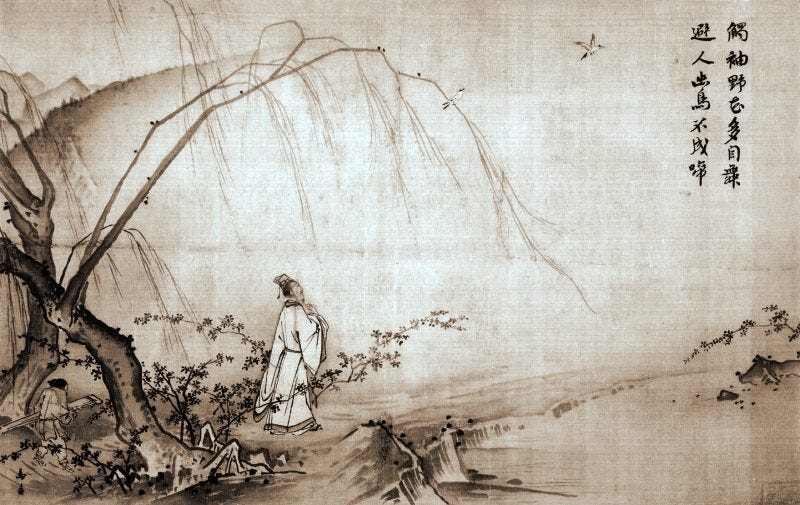
“The wise man knows that it is better to sit on the banks of a remote mountain stream than to be emperor of the whole world.”
—Chuang Tzu
What is meant by a “true man”?
The true men of old were not afraid
When they stood alone in their views.
No great exploits.
No plans.
If they failed, no sorrow.
No self-congratulation in success.
They scaled cliffs, never dizzy,
Plunged in water, never wet,
Walked through fire and were not burnt.
Thus their knowledge reached all the way
To Tao.

The true men of old
Slept without dreams,
Woke without worries.
Their food was plain.
They breathed deep.
True men breathe from their heels.
Others breathe with their gullets,
Half-strangled.
In dispute
They heave up arguments
Like vomit.
Where the fountains of passion
Lie deep
The heavenly springs
Are soon dry.

The true men of old
Knew no lust for life,
No dread of death.
Their entrance was without gladness,
Their exit, yonder,
Without resistance.
Easy come, easy go.
They did not forget where from,
Nor ask where to,
Nor drive grimly forward
Fighting their way through life.
They took life as it came, gladly;
Took death as it came, without care;
And went away, yonder,
Yonder!

They had no mind to fight Tao.
They did not try, by their own contriving,
To help Tao along.

These are the ones we call true men.

Minds free, thoughts gone,
Brows clear, faces serene.
Were they cool? Only cool as autumn.
Were they hot? No hotter than spring.
All that came out of them
Came quiet, like the four seasons.
If you’ve been enjoying the work and aren’t quite ready to subscribe, but still want to support it in some way, you can leave a one-time tip through Buy Me a Coffee — if that’s within your reach.
Every gesture, every note of encouragement, every quiet reader who lingers here — you’ve helped turn this into something rare and luminous: a small, strange, beautiful corner of the internet. I’m deeply grateful. Thank you for being part of it.
Chuang Tzu—also spelled Zhuangzi—was a 4th-century BCE Chinese philosopher and writer, one of the great voices of early Daoism and one of the most free-spirited minds in world literature.
Chuang Tzu taught that the good life is effortless, spontaneous, attuned to the Tao—the natural flow of things. He believed rigid morality, fixed opinions, and political duty distort the human spirit. Freedom comes from unlearning, from loosening the grip of ego, and from moving through the world lightly, like water.
He’s often seen as a sage of laughter, paradox, and deep inward freedom—a thinker who stands outside systems, inviting us not to obey but to wake up. In a world obsessed with control, Chuang Tzu remains the philosopher of letting go, drifting, and discovering a more profound, playful truth.